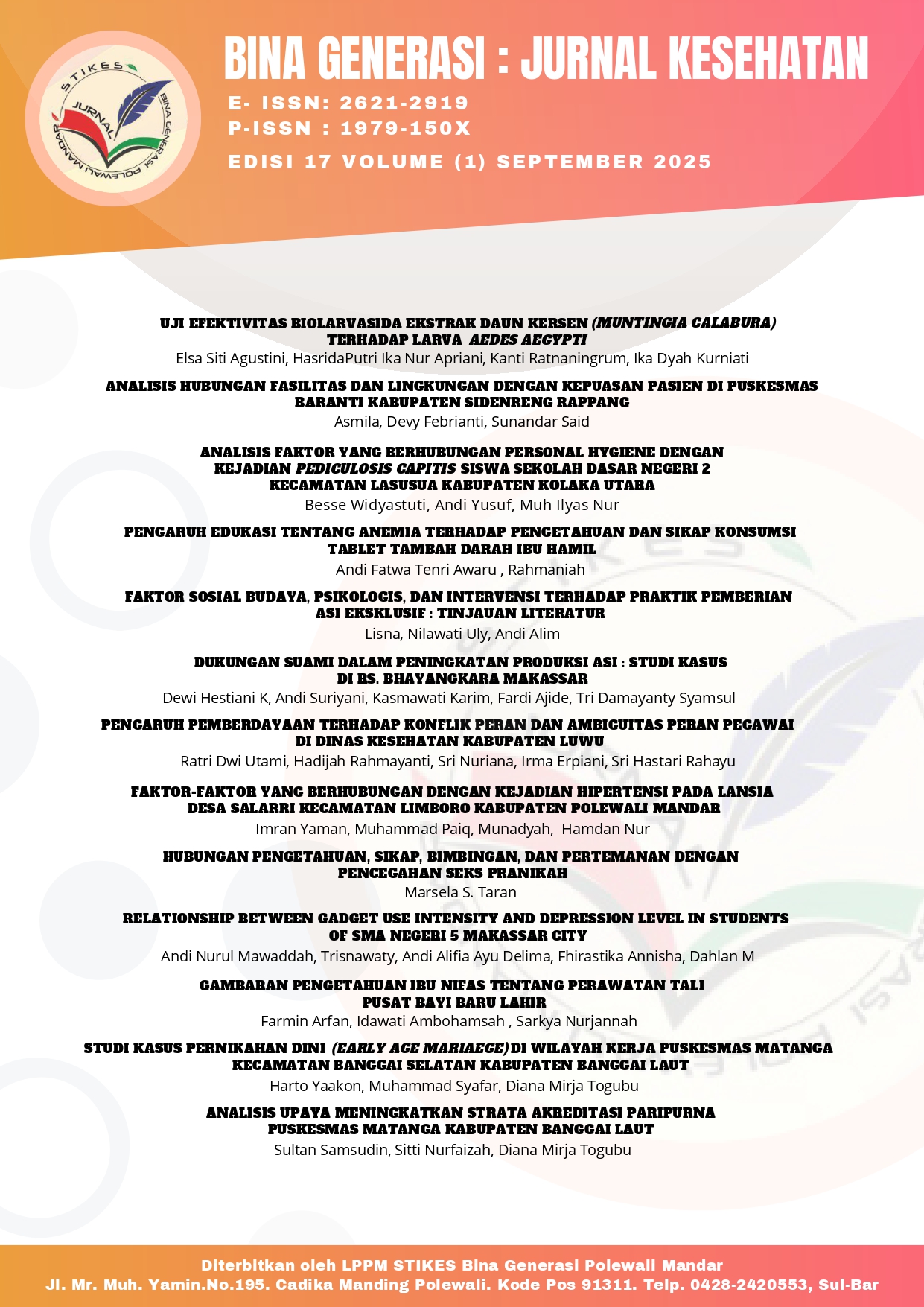
UJI EFEKTIVITAS BIOLARVASIDA EKSTRAK DAUN KERSEN (MUNTINGIA CALABURA) TERHADAP LARVA AEDES AEGYPTI
DOI:
https://doi.org/10.35907/bgjk.v17i1.297Keywords:
tembelakan leaves, cholesterol, karsen leaves, saponin, flavonoid, low-fat diet, Demam BerdarahAbstract
Background: Aedes aegypti has a major role in the transmission of Dengue Hemorrhagic Fever (DHF). Dengue fever is caused by the dengue virus, an arbovirus in the Flaviviridae family. During the last few decades, the prevalence of dengue virus has increased dramatically throughout the world. In 2020 92.8% of all regencies/cities in Indonesia are infected with DHF. The use of plant-derived products, such as plant extracts, can be an alternative to natural larvicides. Kersen leaves contain flavonoids, tannins, saponins and alkoloids. This study aims to determine the effectiveness of biolarvaida kersen leaf extract (Muntingia calabura) against Aedes aegypti larvae.
Method: This research was conducted at the Center for Research and Development of Vectors and Disease Reservoirs (B2P2VRP) Salatiga, with an experimental method using a Post Test Only Control Group Design with 10 treatment groups and 3 repetitions consisting of kersen leaf extract (Muntingia calabura) concentration of 250 ppm, 500 ppm, 1000 ppm, 2000 ppm, 3000 ppm, 4000 ppm, 5000 ppm and 6000 ppm, positive control and negative control. The results of larval mortality were analyzed using the Kruskall-Wallis test and probit analysis.
Result: The test results showed that the mortality rate of the larvae was 20%, 35%, 50%, 60%, 70%, 78.33%, 85%, 96.67% for concentrations of 250 ppm, 500 ppm, 1000 ppm, 2000 ppm, 3000 ppm , 4000 ppm, 5000 ppm and 6000 ppm while a positive control of 100% and a negative control of 0% did not show the death of the larvae. The results of the probit analysis showed LC50 4047 ppm and LC90 7752 ppm.
Conclusion: This study found that kersen leaf extract (Muntingia calabura) could cause death of Aedes aegypti IV instar larvae <50% at 24 hours after treatment and >50% at 48 hours after treatment.
Downloads
References
Andy, A. M. et al. (2021). Identifikasi Senyawa Alkaloid Pada Daun Bidara Arab (Ziziphus spina-christi L.) Menggunakan Metode Spektrofotometri UV-Vis. Indonesian Journal of Pharmaceutical Education, 1(3), 42–51. https://doi.org/10.37311/ijpe.v2i1.11687 DOI: https://doi.org/10.37311/ijpe.v2i1.11687
Aprilianti. et al. (2017). Pengaruh Ekstrak Daun Kersen (Muntingia calabura) Terhadap Kematian Larva Instar III Aedes sp. 42–44. http://repository.unimus.ac.id/919/
Beyer, M. et al. (2020). Health Information Systems. In IT - Information Technology (Vol. 48, Issue 1). https://doi.org/10.1524/itit.2006.48.1.6 DOI: https://doi.org/10.1524/itit.2006.48.1.6
Bharathithasan, M. et al. (2021). Analysis of Chemical Compositions and Larvicidal Activity of Nut Extracts from Areca Catechu Linn Against Aedes (Diptera: Culicidae). PLoS ONE, 16(11 November), 1–15. https://doi.org/10.1371/journal.pone.0260281 DOI: https://doi.org/10.1371/journal.pone.0260281
Cania, E. et al. (2013). Uji Efektivitas Larvasida Ekstrak Daun Legundi (Vitex trifolia) terhadap Larva Aedes aegypti. Journal Medical of Lampung University, 2(4), 52–60. https://juke.kedokteran.unila.ac.id/index.php/majority/article/view/62
Depkes RI. (1995). Materia Medika Indonesia Jilid VI. https://kink.onesearch.id/Record/IOS3954.slims-11660/Description.
Harborne. (1987). Metode Fitokimia, Penuntun Cara Modern Menganalisis Tumbuhan. https://onesearch.id/Author/Home?author=HARBORNE
Harfriani, H. (2012). Efektivitas Larvasida Ekstrak Daun Sirsak dalam Membunuh Jentik Nyamuk. Jurnal Kesehatan Masyarakat, 7(2), 164–169. https://journal.unnes.ac.id/nju/index.php/kemas/article/view/2813
Hernandez, J. R. et al. (2021). Kdr Genotyping (V1016i, f1534c) of The Nav Channel of Aedes Aegypti (l.) Mosquito Populations in Harris County (Houston), Texas, USA, After Permanone 31–66 Field Tests and Its Influence on Probability of Survival. PLoS Neglected Tropical Diseases, 15(11), 1–29. https://doi.org/10.1371/journal.pntd.0009833 DOI: https://doi.org/10.1371/journal.pntd.0009833
Inaba, K. et al. (2022). Molecular Action of Larvicidal Flavonoids on Ecdysteroidogenic Glutathione S-transferase Noppera-bo in Aedes Aegypti. BMC Biology, 20(1), 1–20. https://doi.org/10.1186/s12915-022-01233-2 DOI: https://doi.org/10.1186/s12915-022-01233-2
Isna, H. et al. (2021). Peran Nyamuk Sebagai Vektor Demam Berdarah Dengue (DBD) Melalui Transovarial. http://digital.library.ump.ac.id/1066/
Jemi, R. et al. (2019). Aktivitas Larvasida Ekstrak Daun Tumih (Combretocarpus rotundatus (Miq.) Danser) terhadap Larva Aedes aegypti. Jurnal Ilmu Kehutanan, 13(1), 77. https://doi.org/10.22146/jik.46208 DOI: https://doi.org/10.22146/jik.46208
Lamaningao, P. et al. (2020). Aedes Mosquito Surveillance and The Use of A Larvicide for Vector Control in A Rural Area of The Lao People’s Democratic Republic. Tropical Medicine and Health, 48(1). https://doi.org/10.1186/s41182-020-00242-7 DOI: https://doi.org/10.1186/s41182-020-00242-7
Mazidi, M. et al. (2020). A Greater Flavonoid Intake is Associated with Lower Total and Cause-Specific Mortality: A Meta-Analysis of Cohort Studies. Nutrients, 12(8), 1–14. https://doi.org/10.3390/nu12082350 DOI: https://doi.org/10.3390/nu12082350
Nugroho, A. D. (2013). Kematian Larva Aedes aegypti Setelah Pemberian Abate dibandingkan dengan Pemberian Serbuk Daun Serai. Jurnal Kesehatan Masyarakat, 2013-April(1), 3071–3074. https://doi.org/10.15294/kemas.v7i1.2802
Nur, A. et al. (2022). Skrining Fitokimia Dan Penetapan Kadar Total Fenol. Indonesian Journal of Pharmaceutical and Herbal Medicine, 1(2), 96–104.
Porusia, M. et al. (2021). Larvicidal Activity of Melaleuca Leucadendra Leaves Extract Against Aedes Aegypti. Caspian Journal of Environmental Sciences, 19(2), 277–285. https://doi.org/10.22124/cjes.2021.4745
Pratiwi A A. (2014). Uji Efektivitas Larvasida Ekstrak Daun Kersen (Muntingia calabura Linn.) terhadap Larva Aedes aegypti Linn. Paper Knowledge . Toward a Media History of Documents, 7(2), 107–115. http://eprints.undip.ac.id/43305/
Purnamasari et al. (2017). Potensi Ekstrak Daun Pandan Wangi (Pandanus Amaryllifolius Roxb .) sebagai Larvasida Alami bagi Aedes Aegypti. E-Jurnal Medika, 6(6), 2–6. https://ojs.unud.ac.id/index.php/eum/article/view/31475
Puspa Sari, M. et al. (2019). Efektivitas Ekstrak Daun Maja (Aegle marmelos (L) Corr) sebagai Larvasida Aedes Aegypti. Jurnal Kedokteran YARSI, 27(1), 001–009. https://doi.org/10.33476/jky.v27i1.797 DOI: https://doi.org/10.33476/jky.v27i1.797
Ramayanti, I. et al. (2016). Uji Efektivitas Larvasida Ekstrak Daun Pepaya ( Carica papaya Linn ) terhadap Larva Aedes aegypti. Syifa’MEDIKA, 6(2), 79–88. https://jurnal.um-palembang.ac.id/index.php/syifamedika/article/view/1383 DOI: https://doi.org/10.32502/sm.v6i2.1383
Redo, T. et al. (2019). Larvicidal Activity of Ketapang Leaf Fraction (Terminalia catappa L) on Aedes Aegypti Instar III. Open Access Macedonian Journal of Medical Sciences, 7(21), 3526–3529. https://doi.org/10.3889/oamjms.2019.760 DOI: https://doi.org/10.3889/oamjms.2019.760
Sumuran, M. D. (2022). Antibacterial Activity Test of Ethanol Extraction From Jamaican. 5(1), 36–44. https://ejournal.unsrat.ac.id/index.php/pmj/article/view/41430 DOI: https://doi.org/10.35799/pmj.v5i1.41430
Surjowardojo, P. et al. (2014). Quantitative and Qualitative Phytochemicals Analysis of Muntingia calabura. Journal of Biology, Agriculture and Healthcare, 4(16), 84–89. https://www.iiste.org/Journals/index.php/JBAH/article/view/14486
Susela, E. et al. (2018). Uji Efektivitas Serbuk Daun Kersen (Muntingia Calabura) terhadap Daya Bunuh Larva Aedes aegypti. Jurnal Kolaboratif Sains, 1(1), 334–339. https://jurnal.unismuhpalu.ac.id/index.php/JKS/article/view/365
Syahara, S. et al. (2019). Skrining Fitokimia Ekstrak Etanol Daun Kersen (Muntingia Calabura). Jurnal Kesehatan Ilmiah Indonesia, 4(2), 121–125. https://jurnal.unar.ac.id/index.php/health/article/view/164
Utama, M. S. et al. (2019). Dengue Viral Infection in Indonesia: Epidemiology, Diagnostic Challenges, and Mutations from An Observational Cohort Study. PLoS Neglected Tropical Diseases, 13(10), 1–20. https://doi.org/10.1371/journal.pntd.0007785 DOI: https://doi.org/10.1371/journal.pntd.0007785
Utami, I. W. et al. (2017). Potensi Esktrak Daun Kamboja sebagai Insektisida terhadap Nyamuk Aedes Aegypt. Journal of Public Health Research and Development, 1(1), 22–28. https://journal.unnes.ac.id/sju/index.php/higeia/article/view/14001/7641
Waldetensai, A. (2019). Guideline for efficacy testing of mosquito larvicides Ethiopian Public Health Institute ( EPHI ) Public Health Entomology Research Team ( PHERT ). October. https://www.researchgate.net/publication/336871420_Guideline_for_efficacy_testing_of_mosquito_larvicides
Wasilah, S. Z. (2019). Ekstrak Buah Belimbing manis (Averrhoa carambola L), Larva Aedes aegypti, Larva Culex sp & Larvasida. Αγαη, 8(5), 55. https://garuda.kemdikbud.go.id/documents/detail/1224737 DOI: https://doi.org/10.33758/mbi.v14i4.359
Wira Utami, W. et al. (2016). Uji Aktivitas Larvasida Ekstrak Daun Jarak Kepyar (Ricinus communis L.) terhadap Larva Nyamuk Aedes aegypti. Jurnal Fitofarmaka Indonesia, 3(1), 141–145. https://doi.org/10.33096/jffi.v3i1.174 DOI: https://doi.org/10.33096/jffi.v3i1.174
Downloads
Published
How to Cite
Issue
Section
License
Copyright (c) 2025 Putri Ika Nur Apriani, Kanti Ratnaningrum, Ika Dyah Kurniati

This work is licensed under a Creative Commons Attribution 4.0 International License.
Copyright Notice
- Seluruh materi yang terdapat dalam situs ini dilindungi oleh undang-undang. Dilarang mengutip sebagian atau seluruh isi situs web ini untuk keperluan komersil tanpa persetujuan dewan penyunting jurnal ini.
- Apabila anda menemukan satu atau beberapa artikel yang terdapat dalam JURNAL Kesehatan Bina Generasi yang melanggar atau berpotensi melanggar hak cipta yang anda miliki, silahkan laporkan kepada kami, melalui email pada kontak kami
- Aspek legal formal terhadap akses setiap informasi dan artikel yang tercantum dalam situs jurnal ini mengacu pada ketentuan lisensi Creative Commons Attribution- (CC 4.0).
- Semua Informasi yang terdapat di JURNAL Kesehatan Bina Generasi bersifat akademik.JURNAL Kesehatan Bina Generasi tidak bertanggung jawab terhadap kerugian yang terjadi karana penyalah gunaan informasi dari situs ini.